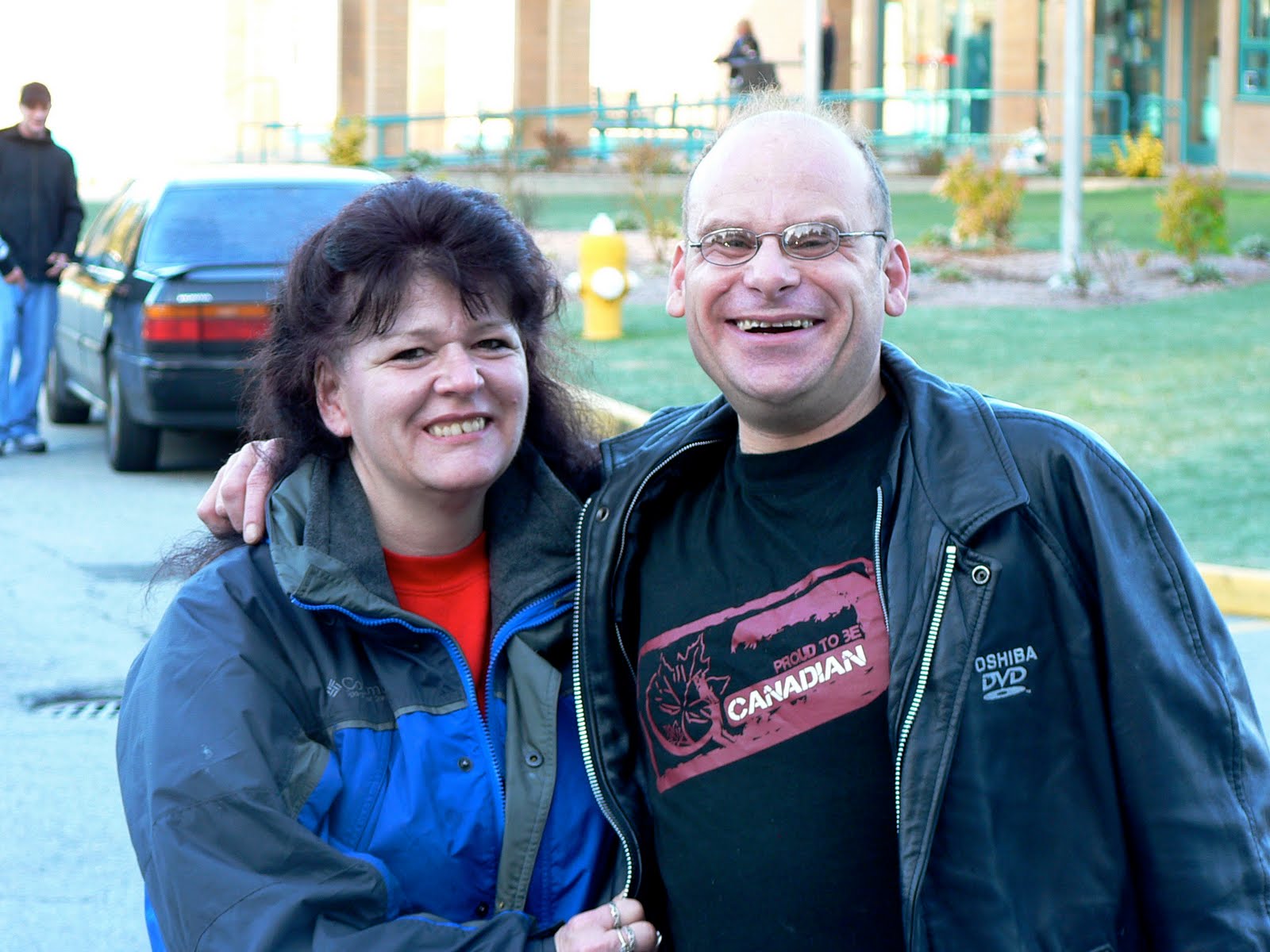
Vancouver Province, July 20, 2010By Claude Adams
 Twice in less than a year, Steve Fonyo has learned a harsh lesson about the limits of Canadian compassion.
The first time came back in December when he heard, while in jail, that he’d been summarily stripped of his Order of Canada—awarded 25 years ago for his epic run across Canada for cancer research.
The second time came last week, when a group in Victoria, BC, withdrew its support for Fonyo’s planned wedding next month, on Fonyo Beach, near Mile Zero, where he ended his run.
The reason: His fiancé, Lisa Greenwood, was in jail for shoplifting, and Fonyo didn’t tell them about it. That bit of dishonesty, along with rumors about other alleged misbehavior, was enough to provoke the Victoria group to yank the welcome mat, along with the flowers, limousine, wedding cake, free hotel accommodation, air tickets and other donations that were pledged.
“We are all God’s children,” said the organizer of the disillusioned Victoria group, John Vickers, but, alas, some “children” are more deserving than others. Call it kindness by contract: I will give you something, if you repay me with displays of virtue. It’s charity that often becomes paternalistic and judgmental--leading to a form of transactional redemption for both donor and recipient.
But it’s not the real thing. Compassion comes without conditions. “Compassion,” said the 19th century American clergyman Henry Ward Beecher, “will cure more sins than condemnation.”
Steve Fonyo’s life is full of sin, and condemnation. I first met Steve in jail last January. He was doing time in a Maple Ridge cell for the latest in a series of mostly petty offenses. His life was a train wreck: no job, no money, few friends and no prospects, and a growing rap sheet.
I picked Steve up on his release date in early February. His clothes were unwashed, and his artificial leg wasn’t functioning. The two-month jail term left him shaken. He said he’d been attacked and almost killed by a fellow inmate. He hobbled into the arms of Lisa, who was also there to greet him, and they hugged for minutes.
On the drive home, he talked about their impending wedding. Steve told me he’d never loved anybody the way he loves Lisa. But it's a rocky relationship. When they arrived at their rented home in Surrey, Steve discovered she’d sold some of his possessions to feed her cocaine habit. He was furious, and he asked me to leave so he could have it out with her. The next few weeks were an emotional whirlwind: they would fight, and make up, and fight again. She burned a manuscript that she had written about their life together. Before she destroyed it, she allowed me to read it. It was a touching document, a love story of two people joined in a communion of addiction and despair.
It was at about this time when John Vickers contacted Steve. Vickers, the director of the Victoria Truth Centre, said he’d like to help Fonyo with his wedding plans. An accomplished fundraiser, he quickly pulled together a network of contributors. “It’s up to us,” Vickers told me in an interview on Fonyo Beach, “to ensure that this (achievement) has a proper footnote in Canadian history.”
Fonyo mused that the wedding would excite national attention, “just like Prince Charles and Lady Diana.” Vickers said he might have to hire security guards. They were like two excited kids, building sandcastles on a beach.
Fonyo lied about Lisa being in jail, because he didn’t want any blemishes on the evolving fairy tale. But Vickers found out anyway. A person close to Fonyo told Vickers that Lisa was in jail, and speculated that she might not even be released before the wedding. And there were other things: rumors about drugs and stolen goods and shoplifting at the Fonyo home. In emails to me, Vickers worried that “many innocent people (were) being truly victimized” by Fonyo’s activities.
I asked him if he had any hard evidence. He didn’t. Could he name somebody who had been victimized? He couldn’t. He acknowledged that his assumptions were “unsubstantiated” and that it may have been a “sorrowful failing” on his part to jump to conclusions. Vickers issued a news release, saying the wedding was off due to “complications.” All the other Victoria donors melted away, all except 88-year-widow Norma Fitzsimmons who told me she would still donate flowers, and solicit other donations, because “I don’t believe in hitting someone who’s already down.”
Fonyo never got to answer the allegations. And, as with the Order of Canada revocation, he never found out who his accusers were.
Steve Fonyo raised an estimated $13 million in the fight against cancer. It was the selfless and reckless act of a teenager driven by a crazy idea that succeeded, against all odds. He never asked for anything in return.
Fonyo is a hard case: rough, often uncouth, prone to anger, insensitive to others, opportunistic, not always truthful. He’s an addict on the road to recovery (he says), and likely suffers from Attention Deficit Disorder. In short, he’s not an easy man to warm up to. “I am what I am,” he says defiantly.
But for all that, Steve Fonyo is what we made him. He’s a product of our culture, a culture that confers celebrity, and then takes it away, and then passes judgment. We created the hierarchy of values that he tried, and failed, to live up to.
In a way, Steve Fonyo holds up a mirror in which we see the reflection of all the things we dislike and disown in ourselves. And that reflection presents us with the challenge to learn what a true community of compassion might look like.
“There’s a whole swath of Canadians across the country who want to see (Steve) get on a better path,” said Vickers. Then he withdrew his offer of help, even though his Truth Centre offers healing for those “in situations less than perfect.”
A wedding won’t save Steve Fonyo. That’s just one of the fantasies he wove, with our complicity. But he doesn’t need or want our approval. What he needs is some trust and compassion--the same kind of raw unquestioning altruism he showed when he started his run, for us, in a Newfoundland snowstorm 26 years ago.
A SPORTSCASTER REACTS
August 6, 2010
I read your article about Steve Fonyo. I appreciate your thoughts, and the article was very well written, but I do not believe Steve Fonyo is worthy of your efforts.
Steve Fonyo ran across Canada to promote himself. To show others he was just as good as Terry Fox, and was able to do anything Terry could do… only better. Steve is not a person who does things without benefit to himself. He is a thief, an addict and an emotional cripple. He has no idea how to run his life, and is… simply put… not a very nice person.
When Steve decided he was going to run across Canada, he walked into the news room at CJIB Radio in Vernon BC, and promptly told News Director Glen Morrison “ I am Steve Fonyo, I am going to do what Terry Fox could not do… what are you going to do for me?”. I know this, because I was there when it happened. I was the Sports Director in the same news room. His attitude was awful, so we sent him packing without a sponsorship. CKAL Radio took the sponsorship and regretted doing so.
For the better part of the next year, we heard and witnessed all kinds of stories about the things Steve did during his Canada wide run. Walking out of restaurants without paying the bill… swearing at people who did not donate…. And being charged with theft in Salmon Arm, for walking out of a Shoppers Drug Mart store with a basket full of personal items.
Even the Canadian Cancer Society threatened to withdraw their approval of the run.
Steve Fonyo does not deserve our compassion.
Make some phone calls to the people who were involved with “the run”. Find out about all the Dirty Little Secrets…!!!
The life and times of Steve Fonyo, would be an interesting read if ALL the details were ever released. He is a Con, and you have been conned (sp). He is no better than a common thief, liar and addict. The only difference is that he is Almost Famous!
He is addicted to the spotlight, and will do anything to keep himself in it.
Sorry, but there are a lot of real people in this world that need our compassion. Steve Fonyo is not one of them.
Craig Jeffers
250-412-9705
August 7
Craig:
Thanks for your note. I wasn't aware of some of the anecdotal stuff you relate about Steve's past.
I view this at two levels. As a journalist, I too look at the accumulation of awful behavior, bad choices, and outright criminality, and am tempted to write him off as a reprobate.
But there's another way to view this. Steve is ill. He's almost certainly ADD (diagnosed in his 20s, and never treated) and he's an addict. He desperately needs therapy and psychological help. I've told him this, and others have too, but it's classic ADD behavior to disregard the best advice.
In a way, the more trouble he causes, the more compassion he is in need of. I'm not a bleeding-heart liberal, but I can see what's in front of me. His life is a cry for help. If we turn away now, he falls deeper down the rabbit hole.
Condemnation is the easiest thing in the world. "Fuck him"--the essence of a lot of the hate mail his story has generated-- slides off the tongue with no effort at all. Caring enough to push him in the direction of help is a little harder. Somebody asked me yesterday "How many times can he fall off his pedestal, and expect us to put him back?" My reply is that WE put him up on the pedestal, possibly against his will, and he never really felt at ease at that height. So let's not try to "put him back"--let's just try to help him find his angle of repose as if he were a brother of a child. That's hard work, and it may be disappointing and even heart-breaking.
But I think it's worth it. Even if he hadn't done something extraordinary for us as a teenager.
Claude Adams
Claude.
I appreciate your reply.
I do not disagree with most of the things you say. But I have had almost 25 years experience, both directly and indirectly with this man, and I feel you have lost sight of the fact that this is not a very nice person.
I respect you for your courage, but suspect you are being a little naïve. This is not a man that will change, but will allow you to help him until he has exhausted every ounce of your patience, energy and time. He’ll take from you whatever he can get, and leave you wondering why you ever thought you could help in the first place.
There have been a lot of well meaning people trying to help him over the years. The “wedding planner” in Victoria is the perfect example. The wedding of a lifetime for Steve and his fiancé… only to be spoiled by the fact that she was in jail and he steals gas!
Maybe before you get more involved, you should investigate a little more. Drive to his hometown of Vernon BC. Interview friends and relatives. Talk to Glenn Morrison, Doug Blackie and Lee Powell about covering the “run”. See why the people in his own home town are embarrassed, and not willing to help any more. He gives a whole new meaning to the term “heart-breaker”.
I wouldn’t call you a “Bleeding Heart”, only a good guy, trying to understand why this guy is so bad. I enjoyed your article. It was fair. But, I would hate to see another person get hurt and be taken advantage of.
**Sorry for the bad grammar…. I was a Sportscaster… not a news guy,.,…. Hahahaha
Craig
AUGUST 7
Craig:
"This is not a man that will change."
Think about that statement a little, and you will see just how wrong-headed it is. Was Fonyo born a lying, cheating, opportunistic heartbreaker? Of course not (unless you believe in the "bad seed" theory). He was "changed" into that lifestyle by circumstances, most of which started young, many of which we are not aware of, and some of which we, his audience, may even have contributed to.
Read some elementary psychology, about how people learn to survive in the world, about how they react to classic punishment and lack of mentoring.
You call me naive; I prefer to believe that I think a little more deeply and critically, and humanely . . . We live in a community of interdependencies: some of us in this community benefit more than others from the compassion that drives the community. Steve fell through the cracks: I'm sure your list of eyewitnesses have a lot of rich anecdotes about how he is "not a very nice person." I don't challenge that assessment: my question is, how did it happen, and what do we do about it?
Was his run across Canada a giant "con" by a wet-behind-the-ears teenager? I was watching in the 80s when he did it, I've also been around the world a few times in my life since then, and met a lot of saints and sinners, and I believe Steve is neither. He's just a thoroughly fucked up kid who swears a lot, cries easily, has terrible relationship problems, and employs some unfortunate survival mechanisms. He gets caught, but as an ADD-stricken guy, compounded by addiction, he doesn't take responsibility, or feel guilt. (Read about this condition. It's very interesting.)
Too many of us, confronted by the Fonyo's of the world, react, as sportscasters are trained to do, with their gut. That makes for good "gutsy" journalism, all black and white and headlining-grabbing and judgmental--a 30-second analysis. But it doesn't go to the heart and the head. And I think that's where you should do to understand Fonyo, and why our smug "gut" reactions don't serve anybody or anything (except maybe the little Stephen Harper that exists in all of us.)
regards
Claude
From Terry Delisle, August 7
Hi..
I just finished reading your rationalism,
on Fonyo`s behavior.
You have some good points.
I am a senior who was planning to attend his wedding
give a nice sum toward starting their new life.
Most all canadians are forgiving ... let the past stay
where it belongs.
But... we are dealing with the present now..that is
not looking any rosier than past misbehavior.
What kind of message then would we send
to the teens these days " rewarding " lawless living
regardless ?
As a parent of four decent law abiding, hard working adult children
I never believed in " unconditional love "
Due to dire circumstances I had to fill in both parent`s role
all by myself, in their formative years.
I was very firm, but fair and loving at the same time.
They got hugs and I love you`s every day.
With one of them I had to use " tough love " when
she did`nt toe the line, keep the rules ( bad outside influences ),
she had to leave our home
and live somewhere else, for 2 years..
Believe me it was a lesson to the 3 younger ones
they never gave me a speck of trouble seeing that.
The troublesome one in her teens got married early
have a better than average marriage
working at a responsible job in the bank for many years
Now at age 52
a happy grandmother and considers me her " best friend "
who helped keeping her on the straight and narrow.
at a time of her crisis.
I think we all feel compassion for Fonyo deep down
and in the long run our prayers will help more, than handouts.
We know Steve and Lisa are incapable of managing no matter
how much we would give.
First some serious, prolonged counselling ( since their parents did`nt do the job )
then help them get on their feet.
respectfully yours : Terry
terry-rose@shaw.ca
Terry:
Here's a thought: Maybe real compassion comes only after the point when you really don't want to give it any more. Think of the drowning man who fights off your efforts to save him. Do you stop trying?
The wedding is a smokescreen. Steve and Lisa embraced the idea for a lot of complicated reasons, but it's a dumb idea. An idea that we, as a society, get very excited about for reasons I'll never understand. A public wedding for them would be a mistake but they don't know it. In a strange way, WE are imposing it on them. We're all hung up on rituals
As you say in your last line, they need counseling. Now. The truly compassionate Canadians will dampen the wedding bells, and focus on getting them both some help
Claude